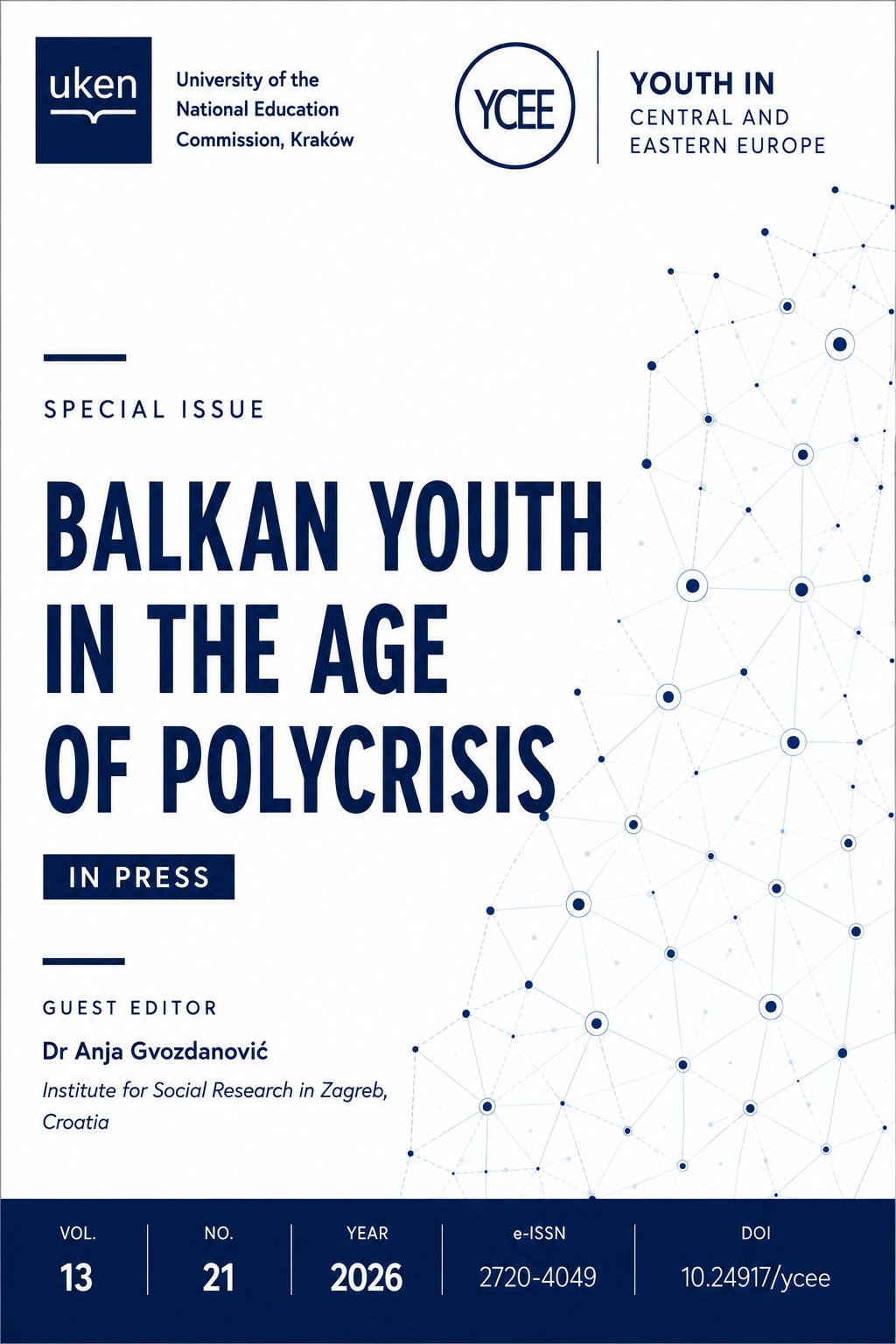
Introduction to the YCEE Special Issue – Balkan Youth in the Age of Polycrisis
DOI:
https://doi.org/10.24917.13594Keywords:
youth in times of crisisDownloads
References
Gordy, E., Ledeneva, A., & Cvetičanin, P. (Eds.). (2025). Captured societies in Southeast Europe: Networks of trust and control. Central European University Press. https://doi.org/10.5117/9789633866436 discovery.ucl.ac.uk
Hasanović, J., Lavrič, M., Adilović, E., & Stanojević, D. (2024). Youth study Southeast Europe 2024: Independent but concerned: The voices of young people in Southeast Europe. Friedrich-Ebert-Stiftung. https://collections.fes.de/publikationen/ident/fes/21457collections.fes.de
Ilišin, V. (2007). Društveni status, problemi i budućnost mladih [Social status, problems and the future of young people]. In V. Ilišin & F. Radin (Eds.), Mladi: Problem ili resurs [Youth: A problem or a resource] (pp. 39–84). Institut za društvena istraživanja u Zagrebu. https://www.croris.hr/crosbi/publikacija/prilog-knjiga/35025
Ilišin, V., & Radin, F. (2007). Mladi u suvremenom hrvatskom društvu [Young people in contemporary Croatian society]. In V. Ilišin & F. Radin (Eds.), Mladi: Problem ili resurs [Youth: A problem or a resource] (pp. 13–37). Institut za društvena istraživanja u Zagrebu. https://idiprints.knjiznica.idi.hr/422/ idiprints.knjiznica.idi.hr
Lavrič, M., Tomanović, S., & Jusić, M. (2019). Youth study Southeast Europe 2018/2019. Friedrich-Ebert-Stiftung. https://collections.fes.de/publikationen/ident/fes/15274 collections.fes.de
Lawrence, M., Homer-Dixon, T., Janzwood, S., Rockström, J., Renn, O., & Donges, J. F. (2024). Global polycrisis: The causal mechanisms of
crisis entanglement. Global Sustainability, 7, Article e6. https://doi.org/10.1017/sus.2024.1
Downloads
Published
How to Cite
Issue
Section
License
Copyright (c) 2026 Anja Gvozdanović

This work is licensed under a Creative Commons Attribution-NonCommercial-NoDerivatives 4.0 International License.
Content published in Youth in Central and Eastern Europe is distributed under the Creative Commons Attribution–NonCommercial–NoDerivatives 4.0 International (CC BY-NC-ND 4.0) license.
Authors retain copyright to their work and grant the journal a non-exclusive license to publish and distribute it. Users are free to read, download, copy and share published articles for non-commercial purposes, provided that proper attribution is given. Commercial use and the creation of derivative works require permission from the copyright holder.